
Informed Citizen
A free, open-source app that shows you what your Congress is actually doing — which bills moved this week, when the House and Senate are next in session, and who represents you. Plus a one-tap handoff to ChatGPT, Claude, or Gemini when you want a bill explained in plain English.
Mission
Bills are written for lawyers. The U.S. Congressional record is, in principle, public — but in practice it's spread across half a dozen government sites, formatted for institutional consumers. Informed Citizen pulls that record into one place, formats it for a phone, and lets you hand the rest to an AI assistant you already trust.
Sources & affiliation
Independent app, not a government project. Informed Citizen is a third-party civic-information tool published by an independent developer. It is not affiliated with, endorsed by, or operated by the U.S. Government, the U.S. Congress, the Library of Congress, any federal or state agency, or any political party, candidate, or campaign.
Where the data comes from. Bill text and metadata come from public records published by the U.S. Congress on Congress.gov (operated by the Library of Congress). Member roster data comes from the open unitedstates/congress-legislators dataset. Session-day data comes from the House Clerk's voting-days ICS feed and the Senate's session XML. The ZIP→district crosswalk is the U.S. Department of Housing and Urban Development's USPS file. Everything is regenerated by GitHub Actions on a published cadence; the Pipeline status page shows freshness for each artifact.
Verify against the source. Every bill row in the app links straight to its canonical Congress.gov page, so you can confirm sponsor, status, and text against the primary record. AI-generated explanations are produced by whichever third-party assistant you hand the bill off to — they are not government-endorsed and may contain errors.
Our commitments
Free, forever. No price tag. No paid tier. No "premium" version waiting in the wings.
No accounts. There is nothing to sign up for. The app has no notion of a user.
No ads, no third-party tracking, no analytics. We don't sell your attention, because we don't collect it.
No personal data leaves your device without your knowing. We don't even collect crash data unless you turn it on in Settings.
The data is public, the code is public. Every bill we show comes from Congress.gov; every line of the app and its data pipeline is Apache-2.0 on GitHub. You can fork it, audit it, or stand up your own copy.
No LLM of our own. When you want a bill explained, the app builds a structured prompt and hands it to whichever AI app you choose. Anthropic, OpenAI, Google, or any share-sheet target — your bill, your AI relationship.
Features
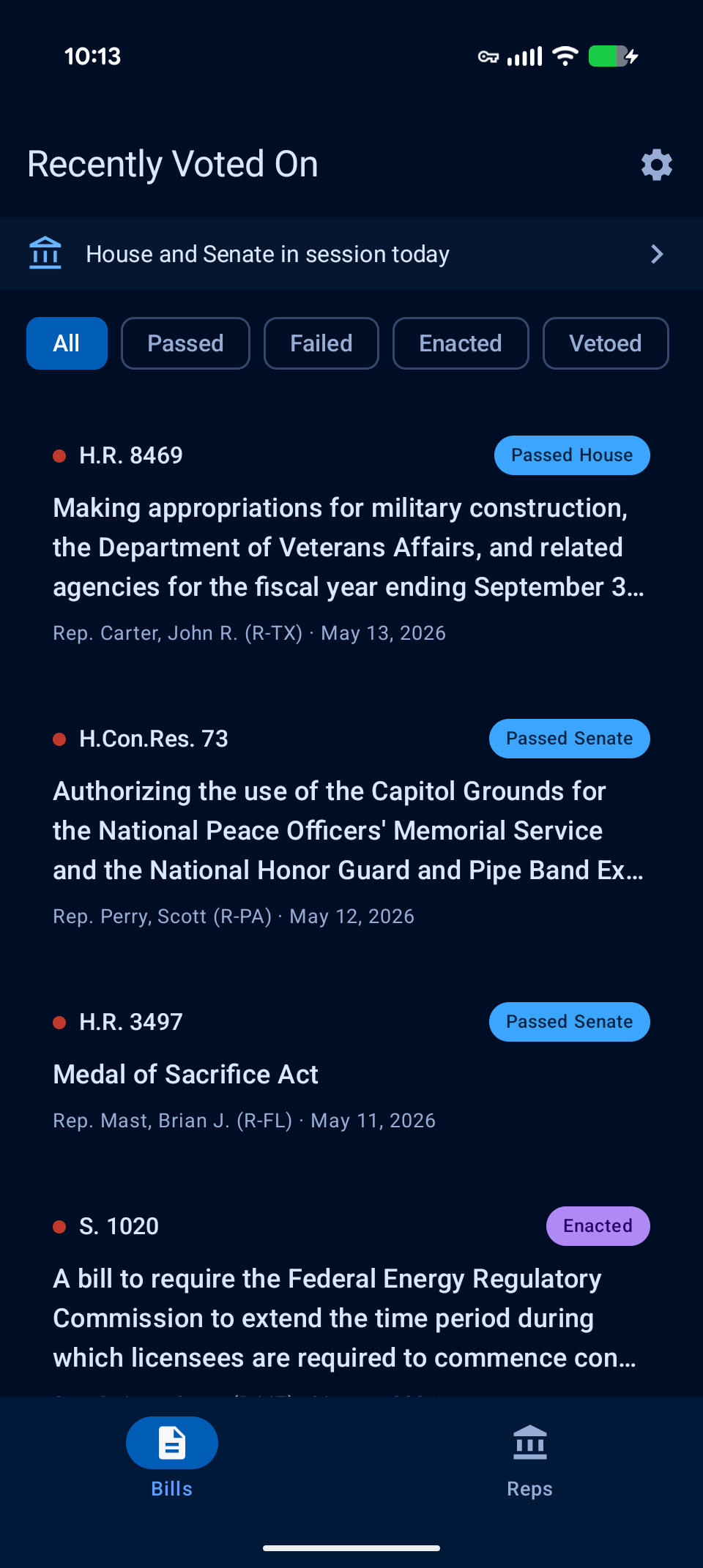
Browse recently voted-on bills.
Filter by passed, failed, enacted, or vetoed. Today's feed covers the 119th Congress, with the 93rd onward backfilled in the background.
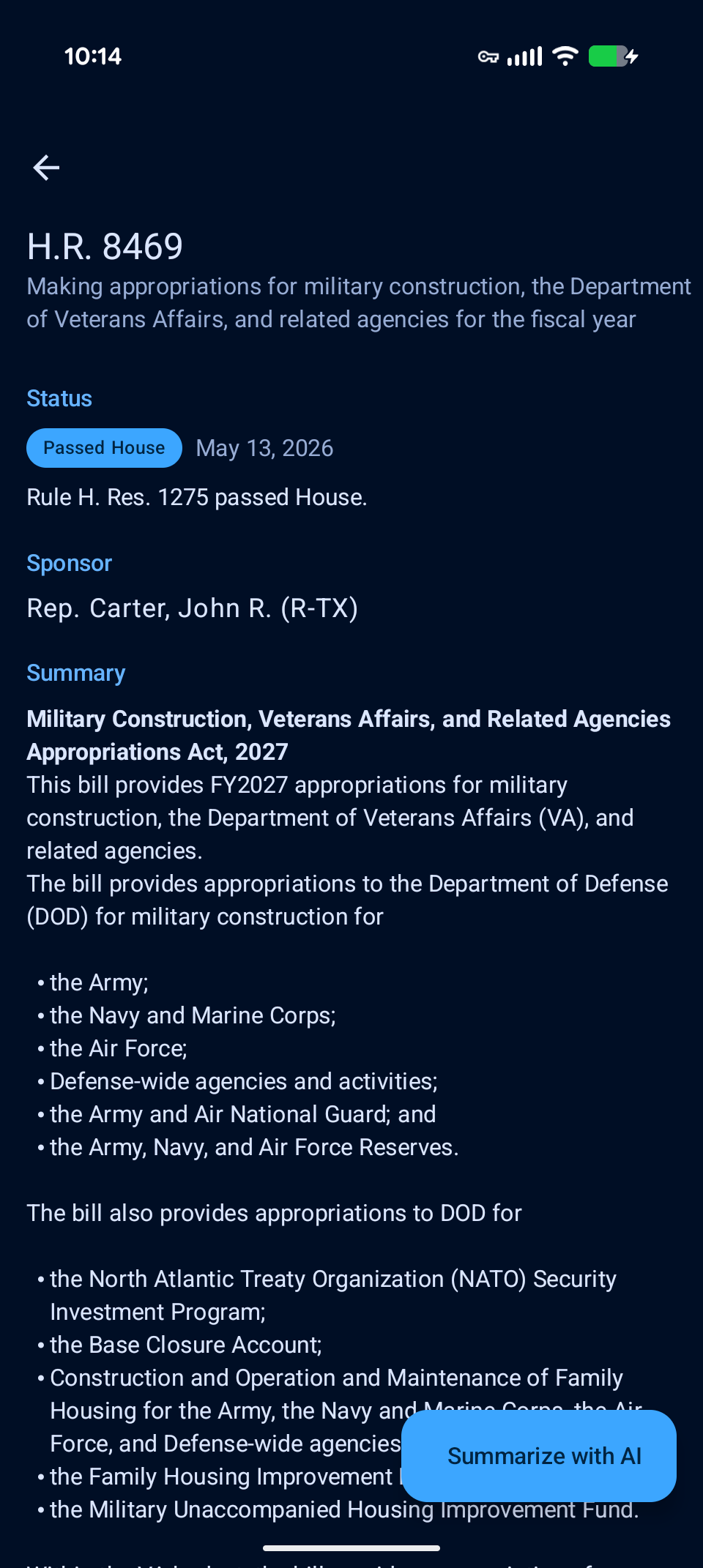
Read a bill.
Sponsor, latest action, and the full Congressional Research Service plain-English summary when one's published. One tap opens the canonical text on Congress.gov; another sends the bill — as a structured prompt — to ChatGPT, Claude, Gemini, or any other app on your device. We ship no AI of our own.
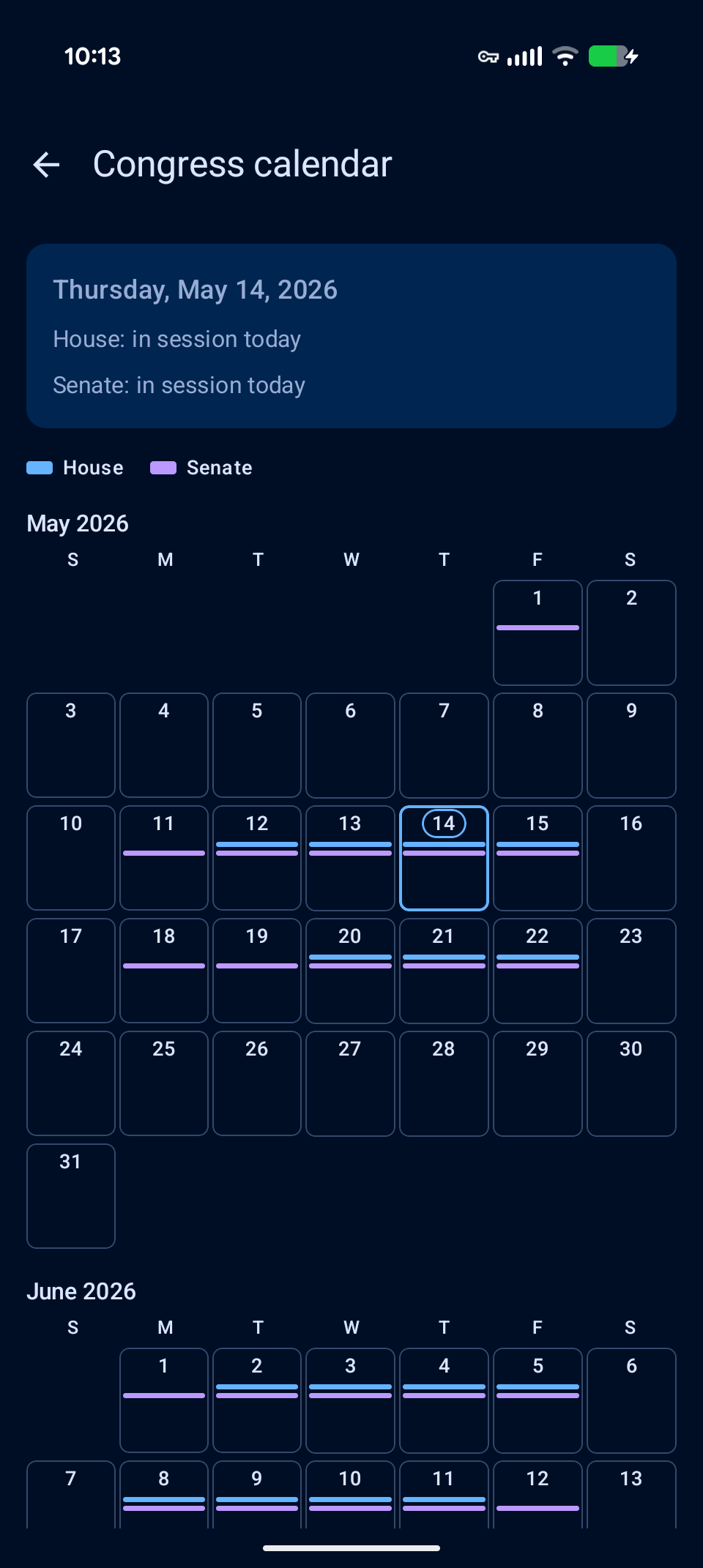
Is Congress in session?
A status line tells you whether the House and Senate are in today, and a calendar grid shows the next two months of session days.
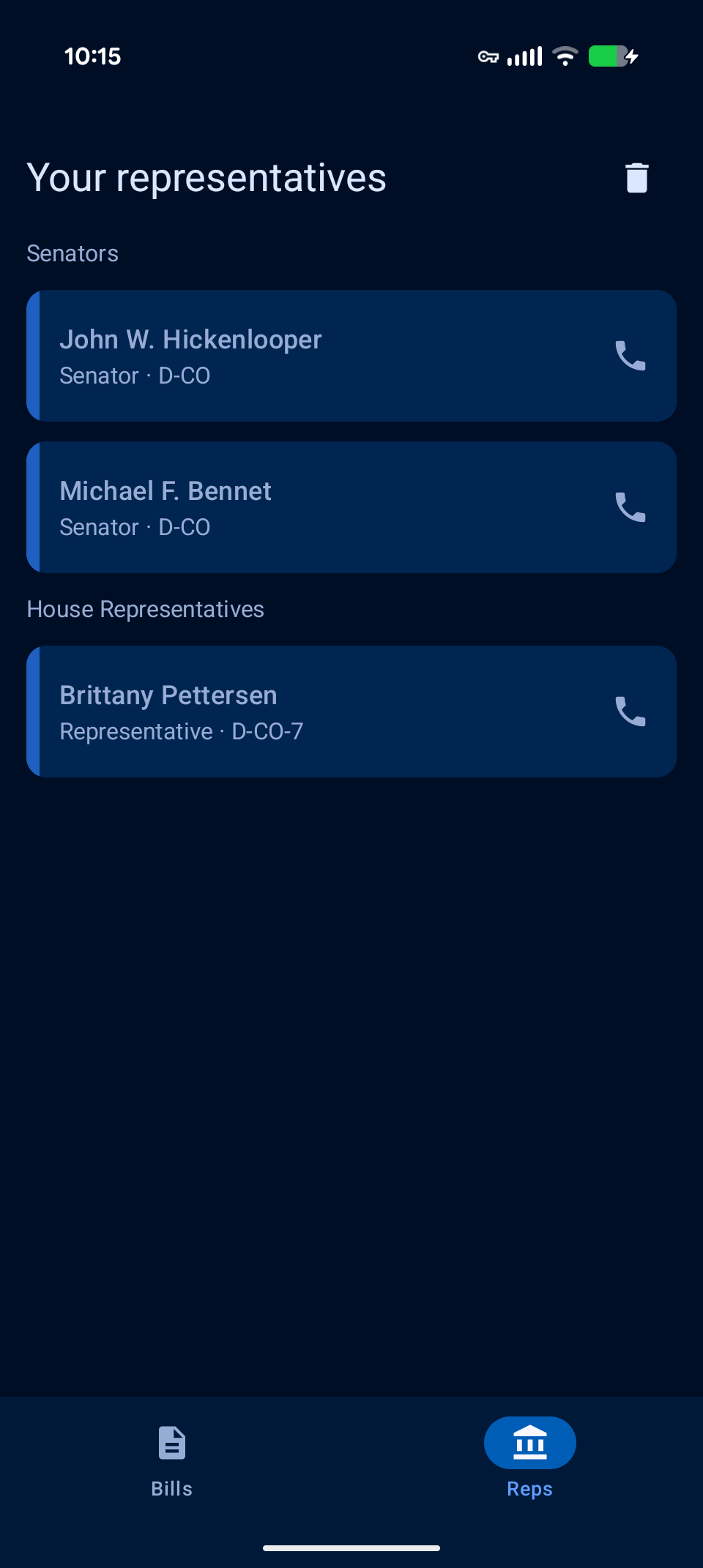
Who represents you?
Save your state and district, or look it up by ZIP and confirm the match. Open any representative's page to see their sponsored and cosponsored bills, dial their D.C. office, visit their website, or reach them on their official social accounts — with a built-in guide to each way to make contact.
Yours to tune.
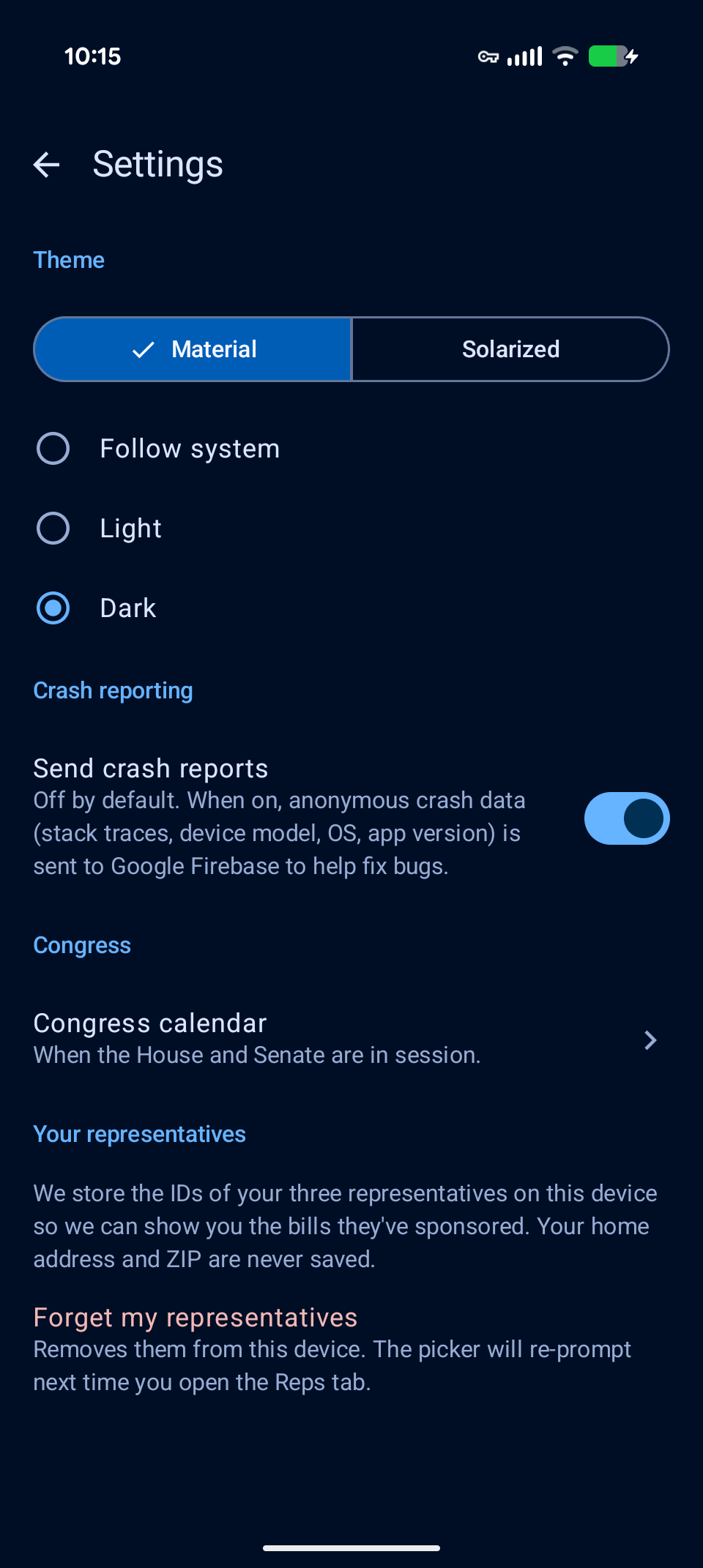
Material or Solarized theme; light, dark, or system. Bring your own free Congress.gov API key to fetch data straight from the source, and an About section lists every data source. Crash reporting is off by default — all on a scrollable Settings screen.
Install
Informed Citizen is in pre-publication review with Google Play. Once it's live, this section becomes a Get-it-on-Google-Play badge. For now, the build-from-source path below works.
git clone https://github.com/nukeforum/bill-summarizer
cd bill-summarizer/android
./gradlew :app:installDebug
Min SDK is Android 8 (API 26). The first build downloads Gradle 9.5.0 and the AGP 9.2.0 toolchain. See the README for the full toolchain notes.
Run your own pipeline
The data the app reads is published as plain JSON to GitHub Pages, built by GitHub Actions workflows from public sources (Congress.gov, the House Clerk's voting-days ICS, the Senate session XML, and HUD's USPS ZIP crosswalk). The whole thing is Apache-2.0, and you can fork it and point it at your own GitHub Pages site so nothing relies on this deployment staying online.